Membrane Nitrogen Generators
On-Site Nitrogen Generation with Membrane Technology
Gaskon membrane nitrogen generators separate nitrogen from compressed air using selective gas permeation through membrane fibres. They can be considered for applications requiring a moderate nitrogen purity, with system selection based on your required flow, pressure, and operating conditions.
Available purity and flow depend on the selected model and operating conditions. Confirm your process requirements with Gaskon Engineers.
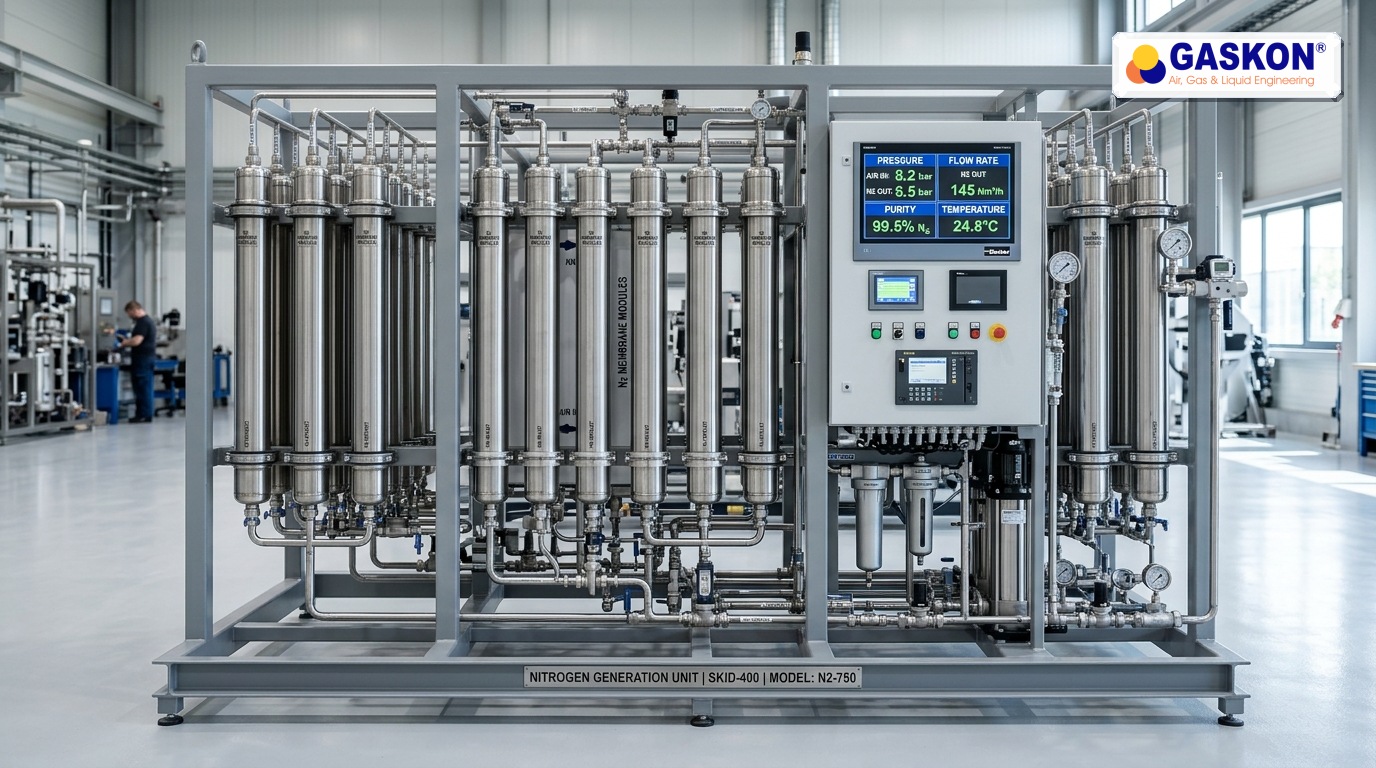
Nitrogen separated from compressed air
A membrane nitrogen generator uses bundles of hollow fibres to separate components of compressed air. As air flows through the fibres, oxygen, water vapour, and other faster-permeating components pass through the membrane wall at a different rate from nitrogen.
The nitrogen-rich gas stream continues through the system to the application. The separation module has no moving parts, while the complete system may include valves, controls, filters, and other equipment.
Membrane technology is often considered where its available purity and flow range match the process requirement. The correct system depends on the application and operating conditions.
Why Membrane Technology?
A continuous separation process
Selective gas permeation through semi-permeable hollow fiber membranes separates fast gases (O₂, CO₂, H₂O) from slow gas (N₂).
Compressed air is supplied
The system receives compressed air at the pressure and quality specified for the selected membrane model.
Air is filtered and conditioned
High-efficiency coalescing filtration and air treatment protect the hollow fibers from oil, particulates, and moisture.
Air enters the membrane module
Compressed air flows through thousands of hollow membrane fibres. Faster-permeating oxygen and water vapor pass through fiber walls.
Nitrogen-rich gas continues to outlet
The purified nitrogen-rich stream flows through the center of the fibers and is directed to the process or storage receiver.
Permeate gas is vented
The oxygen-enriched permeate gas stream that passed through the membrane walls is safely vented to the atmosphere.
A packaged solution based on your site requirements
The required package depends on the selected model, inlet-air quality, nitrogen demand, and installation conditions.
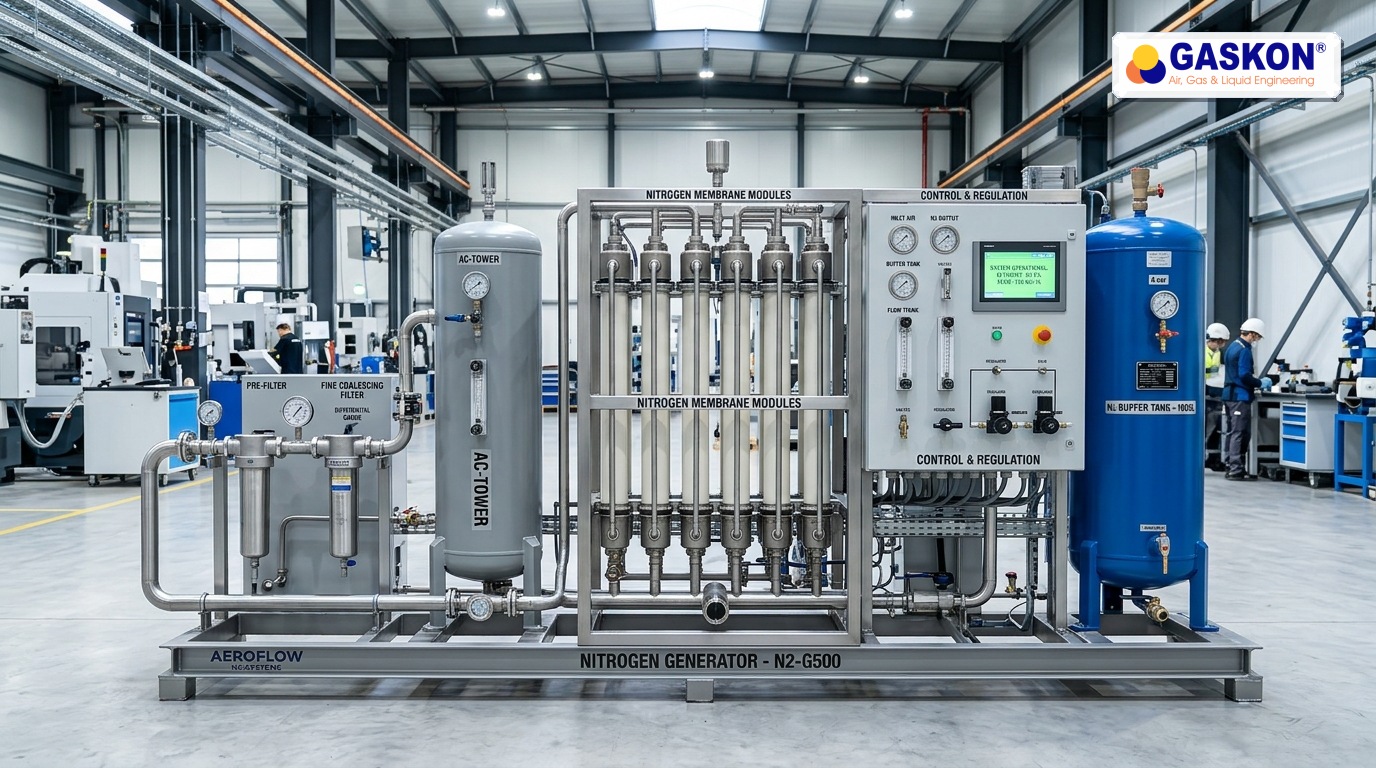
Membrane Separation Module
High-selectivity hollow fiber polymer bundles mounted in stainless steel tubes.
Compressed-Air Supply
Rotary screw compressor providing stable feed pressure between 7 and 24 bar(g).
Air Receiver (Where Required)
Equalizes pressure pulses and supplies volume stability for steady membrane feed.
Moisture Separator & Filters
Coalescing and activated carbon filtration stages remove residual aerosols and oil.
Compressed-Air Dryer
Refrigerant or desiccant dryer conditions incoming dew point to protect fibres.
Pressure & Flow Controls
Precision back-pressure regulator, needle valves, and calibrated flowmeter.
Nitrogen Outlet Connection
Direct delivery manifold equipped with zirconia or electrochemical O₂ purity sensor.
Nitrogen Storage / Buffer Tank
Optional buffer vessel accommodates peak surge demand and safeguards delivery pressure.
A compact approach for suitable applications
Where the required nitrogen purity and flow suit membrane technology, a system offers unmatched simplicity, quiet operation, and space efficiency.
Actual start-up time, installation footprint, purity, flow, and maintenance requirements depend on the selected equipment and site conditions.
On-Site Nitrogen from Compressed Air
Generate nitrogen directly at your point of use, completely eliminating cylinder handling logistics and gas deliveries.
Compact Footprint for Space Constraints
Small physical dimensions and lightweight structure make membrane skids easy to integrate into tight spaces, mezzanines, or mobile containers.
Separation Module with No Moving Parts
Continuous permeation occurs without switching valves, noise, vibration, or cyclical pressure shocks.
Straightforward Process & Rapid Startup
Easy to operate with continuous flow, stable outlet quality, and quick readiness within minutes of powering on.
Ideal for Remote or Offshore Sites
Well-suited for remote installations, offshore platforms, ships, and unmanned facilities where maintenance access is limited.
Check purity, flow, and feed-air conditions together
Nitrogen purity and flow are linked selection factors. The system should be checked against the exact combination of purity, flow, and pressure needed by your process.
Required Nitrogen Purity
Specify acceptable oxygen limits (e.g. 95% for tire filling or blanketing vs 99.5% for sensitive packaging).
Average & Peak Nitrogen Flow
Establish continuous base consumption alongside peak flow requirements (Nm³/hr or SCFM).
Required Outlet Pressure
Membrane systems deliver high direct pressure (up to 24 bar(g)), reducing the need for downstream booster compressors.
Operating Hours & Variation
Duty cycle evaluation: continuous round-the-clock operation, intermittent batch processing, or seasonal variation.
Available Air Pressure & Flow
Feed-air pressure directly influences membrane permeation rate, recovery efficiency, and generator sizing.
Feed-Air Temperature & Quality
Inlet air temperature and purity must be maintained within the optimum envelope to maximize membrane life.
Air Treatment & Filtration
Ensure appropriate particulate, coalescing, and carbon adsorption stages are planned before the module.
Site Location & Space
Footprint restrictions, ambient operating temperatures, indoor/outdoor conditions, and transport accessibility.
Storage / Buffer Tank Need
Determine whether a nitrogen buffer vessel is required to buffer demand spikes and ensure constant line pressure.
Membrane or PSA nitrogen generation?
Membrane and PSA generators both produce nitrogen from compressed air, but they use different separation methods. The best option depends on your required nitrogen purity, flow, pressure, operating conditions, utilities, and project priorities.
Gaskon offers both PSA and Membrane nitrogen generators to match your exact process needs.
Membrane Technology
PSA Technology
Nitrogen for industrial processes
Membrane nitrogen may be considered for applications where its available purity, flow, and pressure meet the process specification. The required nitrogen quality varies by application. Confirm that the selected system meets the process specification before installation.
Food Packaging
Modified Atmosphere Packaging (MAP) for snacks, coffee, nuts, and dry goods, preserving aroma and preventing spoilage.
Chemical Blanketing
Inerting storage tanks, volatile hydrocarbon reactors, and chemical transfer lines to eliminate fire and explosion hazards.
Electronics Manufacturing
Atmospheric inerting during component drying, board cleaning, and storage of moisture-sensitive devices.
Laser Cutting
Assist gas for non-critical cutting operations and sheet metal processing where moderate purity is cost-effective.
Glass Processing
Inert protective atmosphere for glass handling, container manufacturing, and thermal annealing lines.
Oil, Gas & Offshore
Pipeline purging, vessel inerting, offshore platform safety, and shipboard cargo blanketing where compact size is critical.
Frequently Asked Questions
Answers to common questions regarding membrane nitrogen generation, purity ranges, sizing, and remote operation.
What is a membrane nitrogen generator?
What nitrogen purity can a membrane generator produce?
How do I size a membrane nitrogen generator?
Does higher nitrogen purity affect flow?
Does a membrane nitrogen generator need compressed air?
Does the compressed air need a dryer and filters?
Does the membrane module have moving parts?
Can a membrane generator operate continuously?
Is membrane nitrogen suitable for remote sites?
What information should I send for a membrane nitrogen quotation?
Find Out Whether Membrane Nitrogen Fits Your Process
Tell us how you plan to use nitrogen and share the purity, flow, and pressure you require. If you are comparing membrane and PSA systems, include your operating conditions and project priorities so the options can be reviewed.
* Confirm the stated purity range, start-up characteristics, footprint, feed-air requirements, and system components against the exact Gaskon membrane models before publishing.