PSA Nitrogen Generators
Generate Nitrogen On Site with PSA Technology
Gaskon Engineers’ PSA nitrogen generators produce nitrogen from compressed air using pressure swing adsorption. System selection depends on the nitrogen flow, purity, pressure, and operating conditions your process requires.
Available purity depends on the selected model and operating conditions. Confirm your required flow and purity with the Gaskon team.
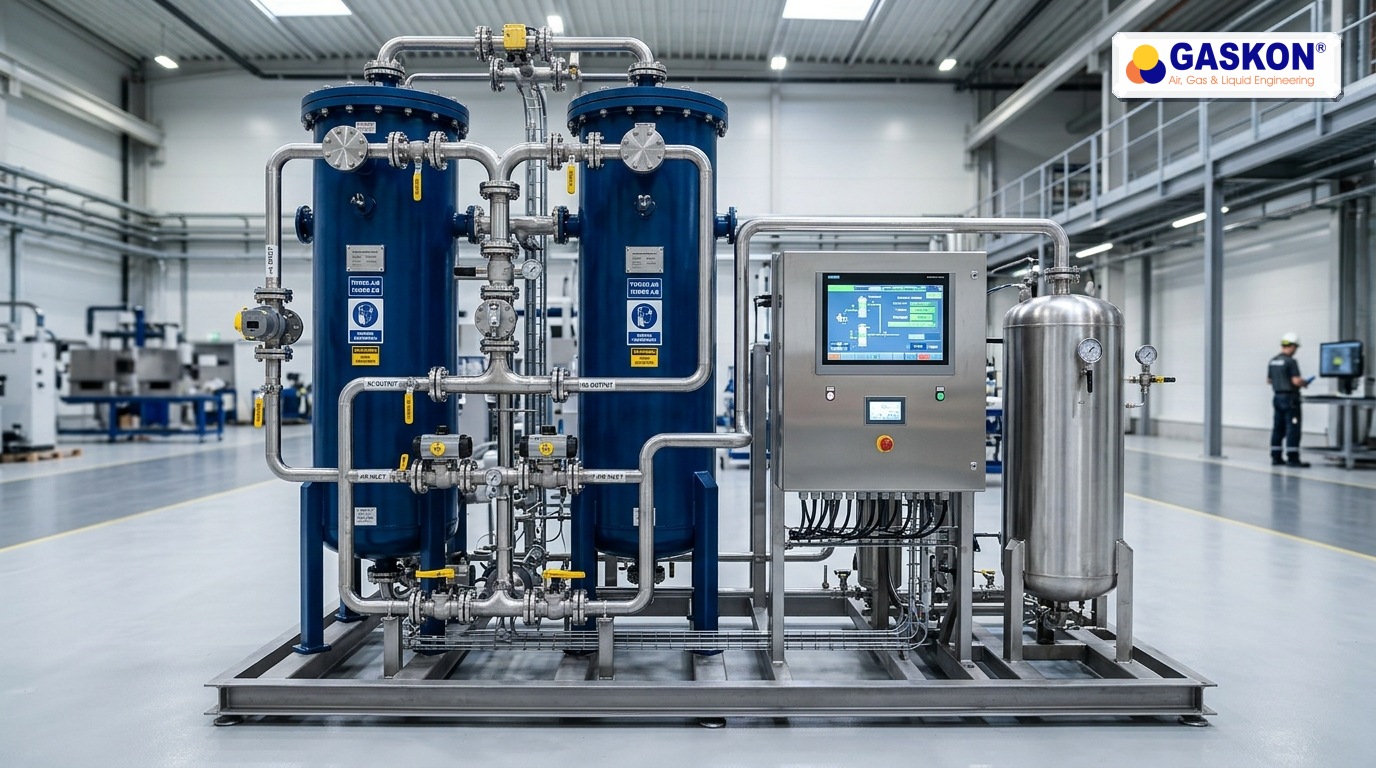
Nitrogen generation from compressed air
A PSA nitrogen generator separates nitrogen from compressed air using adsorbent material called carbon molecular sieve. The system alternates between adsorption and regeneration cycles to produce a continuous nitrogen stream.
PSA systems can be configured for different purity and flow requirements. The right model depends on the process, required nitrogen quality, demand profile, operating pressure, and quality of the compressed-air supply.
Key Operational Highlights
A repeating separation cycle
Pressure Swing Adsorption uses carbon molecular sieves (CMS) to selectively retain oxygen molecules while allowing nitrogen to pass through under controlled pressure.
Compressed air is prepared
Air is compressed and treated through filters and dryers to meet the generator’s strict requirements for moisture, oil, and particles.
Air enters the adsorption tower
The prepared air flows through a tower containing carbon molecular sieve. The sieve preferentially retains oxygen and selected trace gases, allowing nitrogen to pass through.
Nitrogen flows to the process
The nitrogen product moves to a buffer or storage tank and then to the point of use, according to the system design.
The second tower regenerates
While one tower produces nitrogen, the other releases the gases it has retained as its pressure is reduced, venting oxygen back to the atmosphere.
The towers switch cycles
The towers alternate between production and regeneration cycles via automated valve sequencing to maintain continuous nitrogen supply.
A complete system is more than the generator
The configuration depends on the project. A complete PSA nitrogen generation package is engineered as an integrated skid or plant installation.
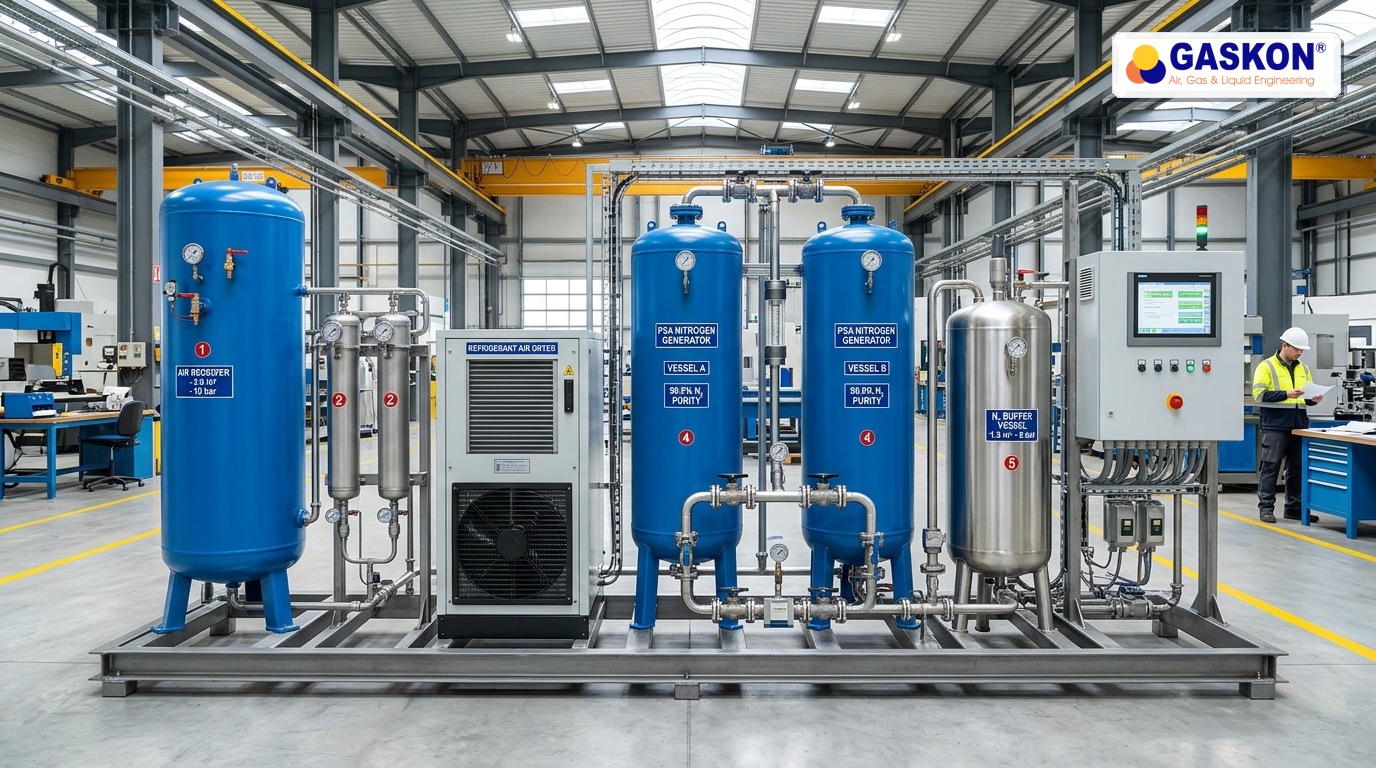
Compressed-Air Supply
Reliable feed-air compressor sized to supply the required pressure and mass flow.
Air Receiver
Dampens pressure pulses and provides buffer volume for consistent flow delivery.
Water Separator
Removes bulk liquid condensate from the compressed air before filtration.
Air Filters
Multi-stage particulate, coalescing, and activated carbon filters protect the CMS sieve.
Compressed-Air Dryer
Refrigeration or desiccant dryer lowers pressure dew point to prevent moisture damage.
CMS Adsorption Towers
Twin pressure vessels packed with high-grade carbon molecular sieve for O₂ separation.
Control System & Instrumentation
Industrial PLC controller with touchscreen HMI, purity analyzer, and automated safety alarms.
Nitrogen Buffer / Storage Tank
Maintains stable delivery pressure and accommodates peak process consumption demands.
Nitrogen Outlet Piping & Valves
Calibrated pressure regulators, flow transmitters, and stainless steel distribution manifolds.
Match purity, flow, and operating conditions
Nitrogen purity and flow requirements need to be considered together. The required purity should be based on the process specification, while the expected average and peak demand help determine capacity.
Required Nitrogen Purity
Define precise O₂ residual limits (e.g. 95% for inerting vs 99.999% for semiconductor processing).
Average & Peak Flow
Establish continuous base consumption alongside peak flow requirements (Nm³/hr or SCFM).
Outlet Pressure
Specify direct delivery pressure needed at downstream points of use (bar(g) or psi).
Operating Hours & Variation
Duty cycle assessment: 24/7 continuous operation, shift-based running, or batch demand.
Air Availability & Quality
Existing compressed air capacity, supply pressure, ambient moisture, and filtration readiness.
Storage Requirements
Determining buffer tank sizing for peak surge handling and backup supply buffer.
Site, Space & Utilities
Footprint availability, ambient indoor/outdoor temperatures, electrical power, and cooling utilities.
Plant Scope
Clarify whether the enquiry is for a brand-new greenfield plant or retrofit into an existing system.
Nitrogen supply designed around your operation
On-site nitrogen generation can be considered when a facility wants to produce nitrogen at the point of use rather than rely only on delivered supply.
Whether it is suitable depends on your demand, operating pattern, purity requirements, installation conditions, and project economics. Actual operating costs, supply continuity, and savings depend on the site and system configuration.
Generate Nitrogen at the Site of Use
Produce pure gas on demand directly where your production processes require it, without logistic disruptions.
Plan Supply Around Your Process Demand
Modulate generator output to match your actual manufacturing schedule and variable flow rates.
Reduce Reliance on Cylinder or Bulk-Gas Deliveries
Minimize exposure to supplier price escalations, delivery delays, hazardous high-pressure bottle handling, and cryogenic boil-off waste.
Select Nitrogen Purity to Suit the Process
Avoid paying for expensive ultra-high purity gas when your process only requires 95% to 98% blanketing quality.
Integrate Generation with Air Treatment & Storage
Seamless turnkey engineering combining compressors, filtration skids, dryers, and customized receiver volumes.
Nitrogen for industrial processes
PSA nitrogen generators are deployed across diverse sectors requiring reliable inert gas. The nitrogen purity, flow, pressure, and quality requirements can vary by application. Confirm the process specification before selecting a system.
Food Packaging (MAP)
Displaces oxygen in sealed packaging to inhibit microbial growth, preserve freshness, and extend food product shelf life.
Pharmaceutical Processes
Inert blanketing for chemical synthesizers, reactor vessels, moisture-sensitive active ingredients, and sterile packaging.
Electronics Manufacturing
Prevents component oxidation during surface-mount technology (SMT), reflow soldering, and nitrogen-purged drying ovens.
Heat Treatment
Protective atmospheres for annealing, hardening, brazing, and sintering furnaces to prevent oxidation and decarburization.
Chemical Blanketing
Inerting storage tanks, piping networks, and flammable vapor spaces to eliminate explosion hazards and prevent product degradation.
Laser Cutting
High-pressure assist gas that expels molten material and produces clean, dross-free, oxide-free edges on stainless steel and aluminum.
Glass Processing
Forms an inert atmosphere over molten tin baths in float glass production, preventing oxidation and surface imperfections.
Custom Industrial Uses
Tire filling, cable manufacturing, offshore platforms, pipeline purging, and custom process gas generation tailored to your needs.
Frequently Asked Questions
Answers to common engineering questions on PSA nitrogen generation, purity ranges, air supply, and sizing.
What is a PSA nitrogen generator?
What nitrogen purity can a Gaskon PSA generator produce?
How do I choose the capacity of a PSA nitrogen generator?
Does higher nitrogen purity affect flow?
Does a PSA nitrogen generator need a compressor?
Why does compressed-air quality matter?
Can a PSA nitrogen generator operate continuously?
Is a nitrogen buffer tank required?
What maintenance does a PSA nitrogen generator need?
What information should I send for a PSA nitrogen quotation?
Discuss Your PSA Nitrogen Requirement
Tell us what your process needs from a nitrogen system. If you know the required purity, flow, pressure, and operating schedule, include those details. If some information is not yet available, send what you have and the team can identify what else is needed.
* Confirm the available purity range, flow rates, pressure range, system components, and operating claims against the exact Gaskon models before publishing.